
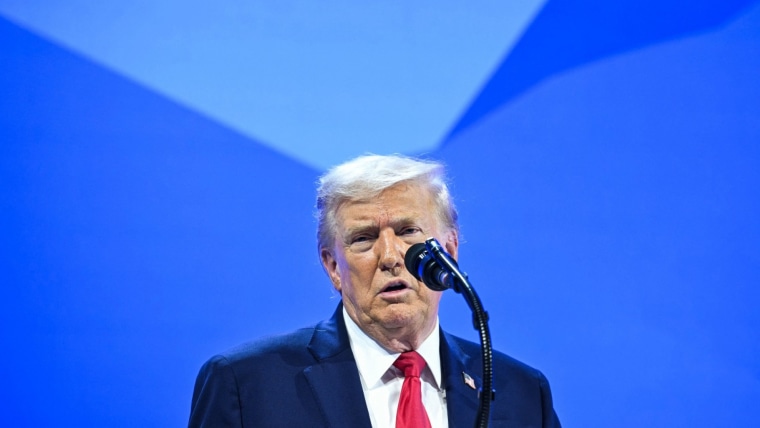
One year into his second term, President Donald Trump declared that the United States is the “hottest country anywhere in the world.”
Trump touted America’s economic power before an audience of global elites at the World Economic Forum on Wednesday, saying the U.S. is seeing “virtually no inflation and extraordinarily high economic growth.”
Tuesday, Trump gave a lengthy briefing to reporters in Washington, holding a stack of papers titled “365 WINS IN 365 DAYS: President Trump’s Return Marks New Era of Success, Prosperity.”
While the American economy has proven resilient, the numbers paint a mixed picture. Inflation is still higher than the Federal Reserve’s target rate, job growth slowed dramatically in 2025, and while energy prices have fallen, Trump has overstated by how much.
Department of Government Efficiency cuts to the federal workforce, Trump’s campaign of mass deportations and his sweeping global tariff agenda are some of the factors that shaped the employment picture during the first year of his second term.
Job growth slowed dramatically last year, with just 584,000 jobs added. That was sharply lower than in each of the previous four years under his predecessor, Joe Biden, when more than 2 million jobs were added every year.
Barring three recession years, 2025 was the slowest 12 months for U.S. job creation since 2003.
Trump promised in the spring that his protectionist economic policy would mean “jobs and factories will come roaring back into our country.” But that hasn’t happened yet.
On the contrary, manufacturing employment has dropped by 72,000 jobs since Trump announced his “reciprocal” country-specific tariffs on April 2, a date he dubbed “Liberation Day.”
While employment fell short of Trump’s early promises last year, U.S. productivity grew by more than what many economists had predicted.
Real gross domestic product, or GDP, increased at an annual rate of 4.3% in the third quarter of 2025, according to an estimate in December by the federal Bureau of Economic Analysis.
During the previous quarter, the annual rate of GDP growth was 3.8%.
The 4.3% GDP growth was the largest quarterly increase since the third quarter of 2023.
The number “reflected increases in consumer spending, exports, and government spending that were partly offset by a decrease in investment,” the BEA said. “Imports, which are a subtraction in the calculation of GDP, decreased.”
Many Wall Street economists forecast fourth-quarter economic growth will be even higher. The Atlanta Federal Reserve Bank estimated GDP for the quarter will be 5.4%.
Consumer spending over the last year has increasingly been driven by wealthier people, while many lower- and middle-income households have pulled back to absorb higher costs of living.
Overall, prices rose 2.7% in December over December 2024. That’s above the Federal Reserve’s 2% target but a strong improvement from the high-water mark of 9% inflation post-pandemic.
Within that 2.7% inflation figure, there were some standout categories.
Since last January, urban electricity prices have risen by an average of 6.7%, according to inflation data from the Bureau of Labor Statistics.
During the same period, the cost of auto insurance increased 0.8% and average monthly housing prices rose 2.8%. Grocery prices rose 1.9%.
But while overall grocery price increases were moderate, costs for some consumer staples soared last year.
The average price of orange juice was up 37.6% from a year ago, according to NBC News’ grocery price tracker data as of last week. The cost of ground beef rose 16.4% in the same period. In both cases, several factors were at work, including weather, diseases affecting oranges and cows, and increased labor costs.
However, the average price of eggs declined more than 20% last year, the NBC News tracker showed.
Gas prices, too, have dropped sharply since Trump returned to office — plunging 11.5% on average since last January.
The price-tracking group GasBuddy projects that gas this year will average $2.97 per gallon, 13 cents less than the average price last year.
Trump exaggerated the drop in gas prices in his remarks Tuesday at the White House, however. He incorrectly said gas prices were averaging $2.31 a gallon. According to AAA, the national average for regular gas was around $2.83 on Wednesday.
Trump also has taken credit for a series of record-breaking new highs for the stock market.
Indeed, major indexes have set records in Trump’s second term, with the S&P 500 and the Dow both closing at all-time highs as recently as Jan. 12.
The S&P 500 gained 13% during the first year of Trump’s second term. But that number doesn’t stand out when it’s set against the market gains during other recent presidents’ first years in office.
During Biden’s first 12 months in office, the S&P rose around 16%. In the first year of Trump’s first term, it jumped around 24%.
But those gains pale in comparison with the 41% returns the S&P delivered in the first 12 months of Barack Obama’s presidency, as the U.S. recovered from the 2008 financial crisis.
Tuesday, the first anniversary of Trump’s second term, was marked by a rout on Wall Street, with the S&P losing more than 2% of its value.
The losses extended to markets around the world and to the other U.S. indexes, with the Dow Jones Industrial Average and the tech-heavy Nasdaq both closing sharply lower.
Driving the sell-off was an exodus from U.S. stocks and bonds known as the “Sell America” trade, as investors dumped shares and weighed the prospect of a trade war between the U.S. and Europe.
Over the weekend, Trump threatened to impose new 10% tariffs on seven European Union countries and Britain unless they support his bid to give the U.S. control over Greenland, a semi-autonomous Danish territory.
On Wednesday, the European Union paused final approval of its July trade deal with the U.S.
But Trump dismissed the fallout from his latest tariff threat.
“The USA is the economic engine on the planet,” he told world leaders in Davos, Switzerland. “And when America booms, the entire world booms.”