
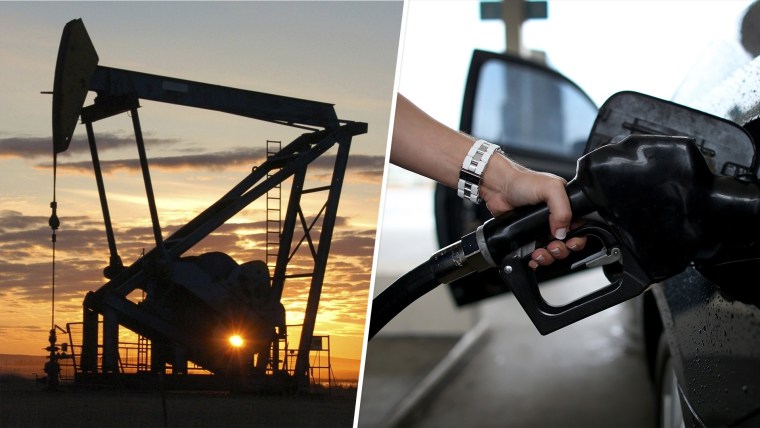
Oil prices swung overnight Sunday, as investors and traders weighed the market forces that could be unleashed by President Donald Trump’s attack on Venezuela and his comments about what could be next for the country and its massive oil reserves.
The price of U.S. crude oil, known by traders as West Texas Intermediate, initially fell when trading began at 6 p.m. ET on Sunday, before rising and falling throughout overnight trading. WTI was higher by 0.3% as of 6:30 a.m. ET Monday.
The international benchmark, known as Brent crude oil, followed a similar pattern. As of early Monday, it was trading higher again, up 0.2%.
Shortly after U.S. forces captured the Venezuelan leader Nicolás Maduro early Saturday, Trump said,“We’re going to have our very large United States oil companies, the biggest anywhere in the world, go in, spend billions of dollars, fix the badly broken infrastructure and start making money for the country.”
Several of the companies that could be well positioned to profit from a surge in oil activity in Venezuela saw their stock prices jump Monday.
Shares of Chevron, the only U.S. energy firm that is currently authorized to operate in Venezuela, soared as much as 10% in pre-market trading. Exxon Mobil and ConocoPhillips shares also rose around 4%.
Oil refiners Valero and Phillips 66 rose around 7%. Shares of energy company suppliers SLB, Baker Hughes and Halliburton also posted gains of between 7% and 9%.
The first of the two forces that traders appear to be balancing is that the overall global instability created by the Trump administration’s intervention and the twin prospects of military conflict and a power vacuum in Latin America could drive up the price per barrel.
The other possibility is that Venezuela will produce and sell more of its vast oil reserves in the future. That would be likely to raise the overall global supply and push down prices.
Restoring Venezuela’s energy industry would most likely take years and billions of dollars of investments, however. As of Sunday evening, it was unclear where that money would come from or who would assume the massive risks involved and, consequently, reap the profits.
Futures markets, which indicate where stocks will likely open at 9:30 a.m. ET were higher. S&P 500 futures were traded up early on Monday by 0.3% while Nasdaq 100 futures jumped 0.8%.
Precious metals, a perennial safe haven for investors in times of global turmoil, also posted sharp gains.
Gold rose more than $90, or over 2.1%, while silver rose nearly 4%.
Separately Sunday, OPEC, of which Venezuela is a founding member, decided to hold its collective oil output steady. The group did not comment on the developments in Venezuela.
Venezuela has the largest oil reserves in the world, surpassing those of even Saudi Arabia, Iran, Iraq and the United Arab Emirates. But because of a lack of investment and a poor economy, Venezuela exports very little crude oil.
Restoring Venezuela’s energy infrastructure even just to where it was in the 1990s would require $8 billion of direct investment, the state-controlled oil company PDVSA has estimated.
Securing the money would be made all the more difficult by the fact that major oil and gas companies have been reducing the amount they spend on upgrading equipment like pipelines and refineries in recent years — one way they have responded to the drop in oil prices.
In 2025, the prices of both U.S. crude oil and Brent crude oil posted their largest annual drops since 2020.
Even before the Trump administration’s intervention in Venezuela, the commodity trading firm Trafigura’s chief economist, Saad Rahim, predicted the oil market faces a “super glut” of supply, which would be likely to drive oil prices even lower.